What is taken from the public should not be hidden from the public.
Transparent Money
A privacy-preserving architecture for real-time public spending transparency.
Transparent Money is a proposal to make public money visible to the last cent. Its wider purpose is to make public spending, tax collection, money creation and extinguishment, and aggregate economic flows visible and searchable in near real time. Because money itself is tracked, attempts to omit, delay, falsify, or misrepresent those flows would become harder to hide.
Why public money should be visible
If taxes are taken from the public, why can the public not see where that money goes with the same ease and clarity with which we check our own bank accounts?
Imagine opening your phone and seeing how much your local council, city hall, government department, hospital, school, or public agency has spent today: electricity bills, water use, maintenance contracts, grants, procurement payments, salaries, suppliers, subsidies, and transfers.
Imagine being able to compare that information meaningfully across councils, cities, regions, hospitals, schools, or public bodies. Why does one building spend much more on energy than another? Why does one council pay more for the same service? Why is the same service being purchased again and again?
If this kind of visibility existed, the space for corruption, waste, favouritism, overpricing, poor management, and insider advantage would be much smaller. Public money should be visible, searchable, comparable, and understandable.
What is Transparent Money?
Transparent Money is not a new currency, not a central bank digital currency, and not a payment system. It is a proposed public, structured, privacy-preserving information layer built around existing money and existing banking infrastructure.
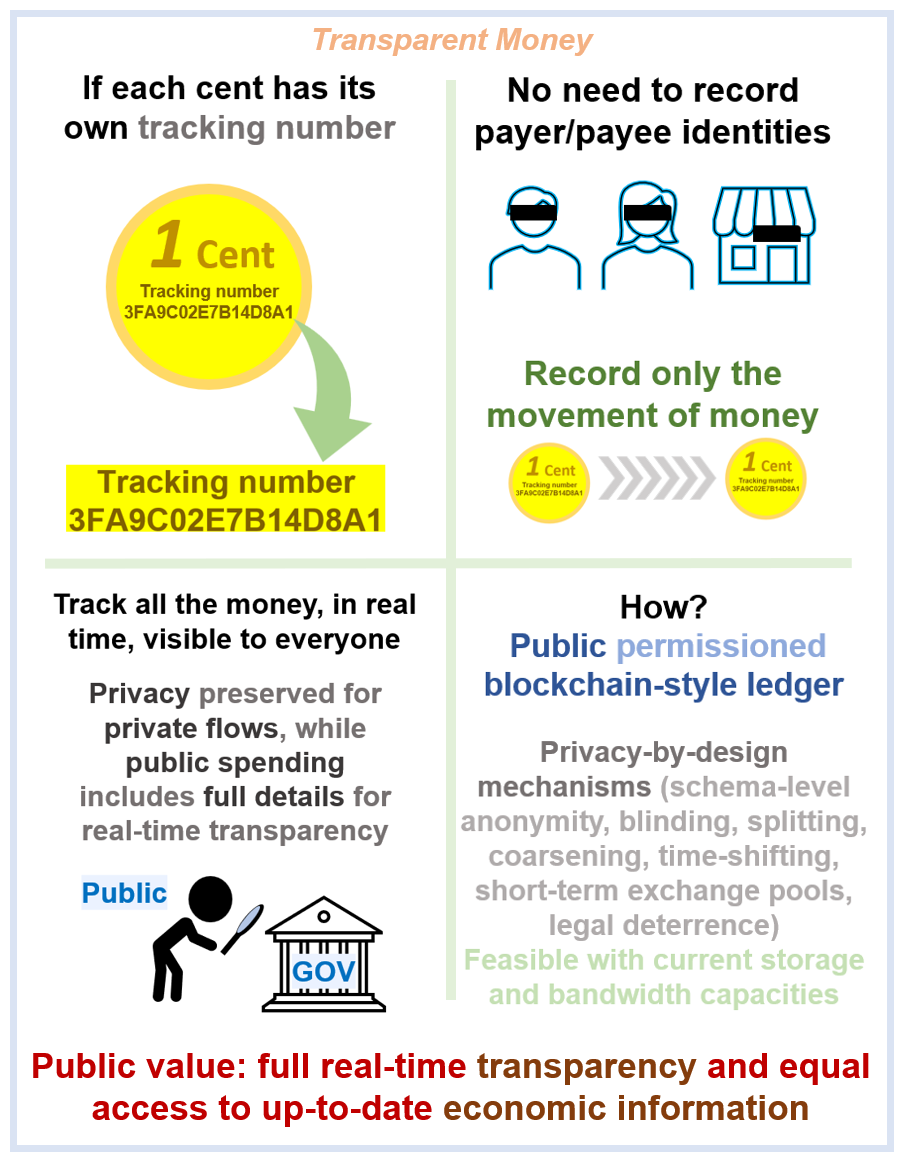
Its central idea is that money can be traced without tracing people. If each digital cent has a tracking number, then the movement of money can be recorded by following the money itself, without recording the names of payer and payee. The public record does not need those names because money itself has identity.
The core idea
Why it matters
Public spending transparency is often delayed, fragmented, technical, and difficult for ordinary citizens to understand. Transparent Money aims to transform fiscal transparency from occasional disclosure into continuous visibility. Citizens, journalists, researchers, businesses, and policymakers could see how public money is collected, transferred, and spent in real time. Because it would also provide useful information about the economy, it would not depend only on civic interest: many people would use it because it would help them make better decisions.
The wider benefit is economic. A public, privacy-preserving map of money flows could improve public accountability, reduce waste and corruption, weaken insider information advantages, and give citizens and businesses better information for decision-making. Millions of small improvements, accumulated year after year over decades, could work like compound interest for society.
Privacy by architecture
Transparent Money is designed to reverse the growing tendency to make citizens increasingly visible to the state. It proposes using technology in the opposite direction: not to monitor private life, but to make government visible, because government must be accountable to citizens. Private identities are not published in the public ledger. Private transactions use generic codes and broad descriptors, while public transactions carry higher detail because they involve public money.
Additional protections can include splitting unusual amounts into common denominations, coarsening time and location, generalising private transaction categories, and using short-term exchange pools to exchange tracking numbers. This helps stop inference when an actor knows an external transaction pattern and might otherwise try to follow another person’s or firm’s money path.
More information
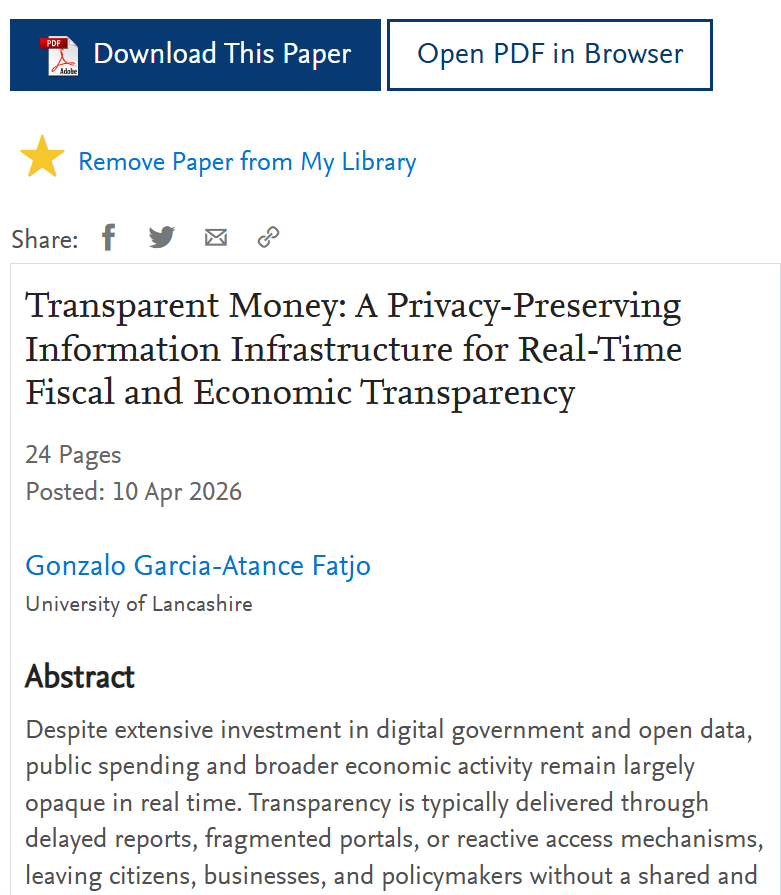
Transparent Money: A Privacy-Preserving Information Infrastructure for Real-Time Fiscal and Economic Transparency
SSRN preprint by Gonzalo Garcia-Atance Fatjo.
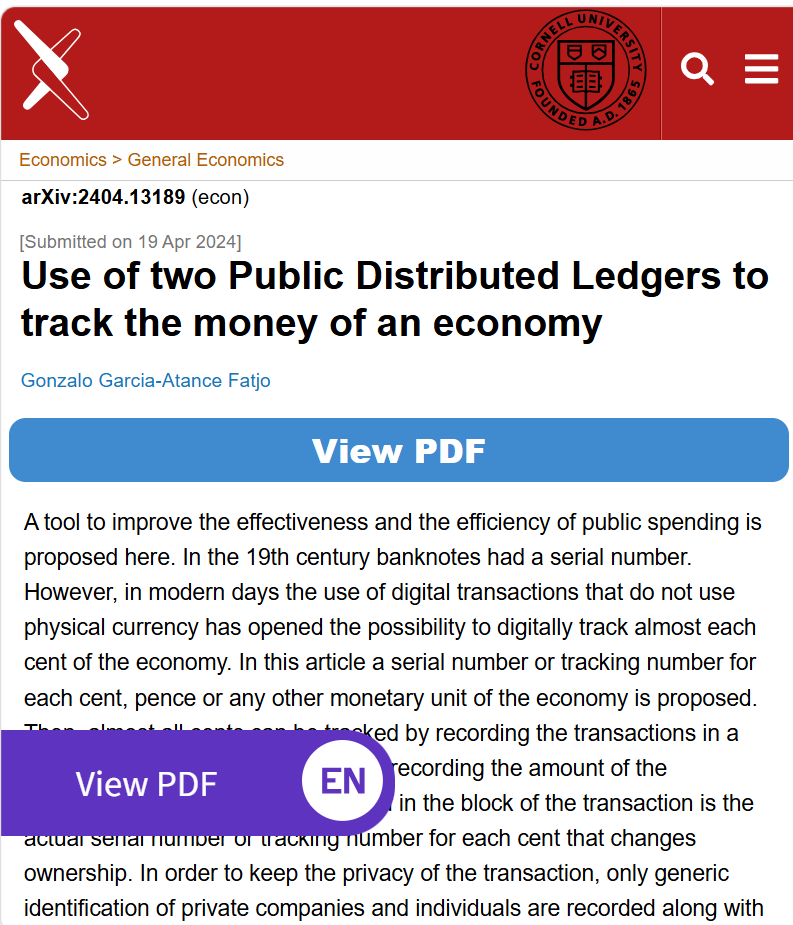
Use of Two Public Distributed Ledgers to Track the Money of an Economy
arXiv preprint by Gonzalo Garcia-Atance Fatjo.
Transparent Money has been submitted to the Call for Evidence for the United Kingdom’s Seventh National Action Plan for Open Government.
Transparent Money has also been submitted to the European Commission’s Call for Evidence on the EU Anti-Corruption Strategy: “A comprehensive approach to tackling corruption within the EU and beyond” .
Feedback and invitations
Comments, criticisms, corrections, privacy concerns, technical feedback, academic discussion, media enquiries, conference invitations, and dissemination opportunities are welcome.
Messages are reviewed privately and will not be published without permission.
Author
Transparent Money is a research and public-good concept developed by Dr Gonzalo Garcia-Atance Fatjo.
This website will link to publications, preprints, conference papers, videos, and related work as the project develops.